Navigating the world of decentralized finance often feels like stepping into a gold rush where the rules change daily. Yield farming, liquidity provision, and decentralized exchanges promise significant returns, but they also carry steep learning curves and hidden technical risks. For many investors, the gap between holding cryptocurrency on a centralized exchange and actively generating yield on a decentralized network is daunting, leading them to seek out structured educational programs to bridge the knowledge gap.
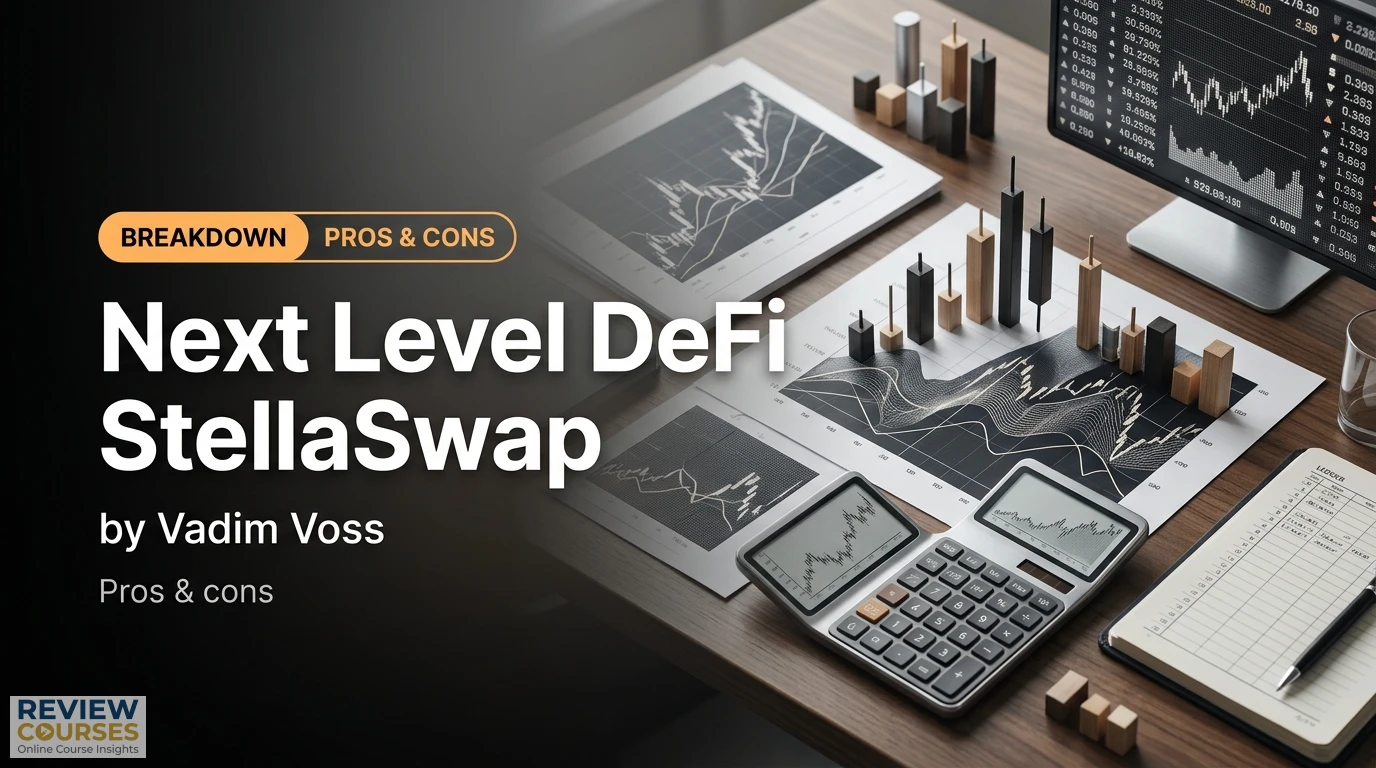
This brings us to the Next Level DeFi StellaSwap Course, a high-ticket training program created by Vadim Voss. Designed to demystify a very specific corner of the crypto ecosystem, this course focuses heavily on the Moonbeam network and its premier decentralized exchange, StellaSwap. Rather than offering a broad, generalized overview of all things crypto, the curriculum zeroes in on actionable strategies for setting up wallets, bridging assets, and deploying capital into liquidity pools.
However, with an official price tag of $1,997, prospective students face a critical decision. Is a highly specialized course focused on a single decentralized exchange worth a premium investment, especially when the crypto landscape is known for rapid shifts and high volatility? Furthermore, how does the reality of impermanent loss and smart contract risk stack up against the program's marketing claims?
This review provides a comprehensive, technical deep-dive into the Next Level DeFi Academy. We will examine the confirmed curriculum, evaluate the instructor's background, break down the inherent risks of the StellaSwap strategy, and help you determine if this high-ticket course aligns with your capital, risk tolerance, and educational needs.
At a glance
|
Item |
Details |
|
Course Name |
Next Level DeFi StellaSwap Course |
|
Provider / Instructor |
Vadim Voss |
|
Category |
Crypto & Investing |
|
Intent Fit |
Commercial Investigative |
|
Buyer Stage |
Decision |
|
Pricing Transparency |
Confirmed ($1,997 for the core masterclass) |
|
Policy Transparency |
Not verified (Refund policies are not explicitly stated in public snippets) |
|
Trust Signal Status |
Likely (Instructor has verified NYU Stern background and community presence) |
What this review helps you decide
|
Question |
Why it matters |
|
Is the $1,997 price justified? |
High-ticket crypto courses require you to have a substantial separate bankroll to generate a meaningful return on your educational investment. |
|
Is the Moonbeam ecosystem too complex? |
Operating on Polkadot parachains requires specific wallet setups and bridging knowledge that goes beyond basic Bitcoin or Ethereum transactions. |
|
What are the real risks involved? |
Yield farming is often marketed as passive income, but it carries severe risks like impermanent loss and smart contract vulnerabilities. |
|
Are there viable free alternatives? |
Much of the mechanical knowledge required to use decentralized exchanges is available for free in official documentation and video tutorials. |
Course overview
The Next Level DeFi StellaSwap Course is a specialized training program that teaches students how to navigate and profit from the decentralized finance ecosystem, specifically targeting the Moonbeam network. It is crucial to distinguish between the educational platform and the technology it teaches: Next Level DeFi is the academy founded by the instructor, while StellaSwap is an independent decentralized exchange (DEX) operating on the Moonbeam parachain within the Polkadot ecosystem. The course does not own or control StellaSwap; it merely teaches you how to use it.
The instructor brings a verified professional background to the table, holding credentials from NYU Stern and boasting over two decades of entrepreneurial experience. This background lends a degree of traditional financial credibility to the program, which is often lacking in the anonymous world of crypto influencers. The course is marketed heavily toward individuals looking to generate yield on their crypto assets, often utilizing "passive income" terminology that naturally attracts scrutiny.
Searchers looking into this program are typically trying to verify its legitimacy and understand if the specific strategies taught offer a unique edge. The Moonbeam network, which uses the GLMR token for gas fees, is highly interoperable but can be technically intimidating for beginners. The course aims to flatten this learning curve by providing step-by-step instructions on moving fiat currency into the crypto ecosystem, bridging it to the correct network, and deploying it into liquidity pools to earn trading fees and reward tokens.
What’s likely inside the course
Based on verified curriculum breakdowns, the program is structured into six core modules designed to take a user from zero decentralized finance experience to active liquidity provision.
|
Theme area |
What it likely covers |
Confidence |
|
Module 1: Initial Setup |
Installing Metamask, securing seed phrases, and setting up a VPN for operational security. |
Confirmed |
|
Module 2: Fiat On-ramps |
Navigating centralized exchanges like Coinbase or Binance to purchase initial assets and transfer them to self-custody wallets. |
Confirmed |
|
Module 3: DeFi Theory |
Understanding the mechanics of liquidity pools, automated market makers (AMMs), and the critical concept of impermanent loss. |
Confirmed |
|
Module 4: StellaSwap Platform |
A deep dive into the specific DEX interface, connecting wallets, and navigating the Moonbeam network. |
Confirmed |
|
Module 5: Yield Optimization |
Strategies for selecting the best liquidity pools, compounding rewards, and managing farm tokens. |
Confirmed |
|
Module 6: Risk Management |
Mitigating smart contract risks, understanding tokenomics, and knowing when to exit a position. |
Confirmed |
Who this is for
This program is primarily designed for individuals who already have a foundational understanding of cryptocurrency but feel overwhelmed by the mechanics of decentralized finance. It caters to those who prefer a highly structured, step-by-step video format over piecing together fragmented tutorials from various online sources. Because the course requires a significant upfront investment, it is best suited for individuals who have a dedicated, expendable bankroll ready to deploy into yield farming strategies.
|
If you are… |
This may fit if… |
This may not fit if… |
|
A crypto beginner |
You want a hand-held, step-by-step guide to setting up your first Web3 wallet and making your first decentralized trade. |
You have less than a few thousand dollars to invest, making the $1,997 course fee a disproportionate expense. |
|
An intermediate investor |
You understand centralized exchanges but want to learn the specific mechanics of the Polkadot and Moonbeam ecosystems. |
You already know how to bridge assets, provide liquidity, and calculate impermanent loss on other networks. |
|
A passive income seeker |
You are willing to actively monitor your positions and understand that "passive" in DeFi still requires regular portfolio management. |
You expect guaranteed, risk-free returns or believe that high APRs will last indefinitely without token depreciation. |
Learning experience and format
The learning experience in the Next Level DeFi Academy is heavily focused on over-the-shoulder technical demonstrations. Because decentralized finance requires precise clicks, network selections, and contract approvals, the video format is essential. Students can expect detailed walkthroughs of setting up a Metamask wallet, adding the Moonbeam RPC network, and executing cross-chain bridges to move assets like DOT or stablecoins into the ecosystem.
While the core curriculum is confirmed to cover these six modules, the exact length of access, the availability of ongoing community support, and the frequency of curriculum updates are not specified in public snippets. Given how rapidly decentralized exchange interfaces and network bridges evolve, prospective students should verify with the provider how often the video materials are updated to reflect the current state of the StellaSwap platform.
If you are exploring different instructional styles for decentralized finance, you might compare this highly specific DEX approach to broader yield strategies found in programs like darren Jenkins' Defi Income Optimizer, which tackle market opportunities from a different angle. Ultimately, the format here is highly tactical, focusing less on broad macroeconomic crypto theory and more on the exact buttons to click to start farming yield on a specific platform.
Pros and cons
|
Likely strengths |
Possible drawbacks or open questions |
|
Provides a highly structured, linear path for navigating the complex Moonbeam ecosystem. |
The $1,997 price tag is a massive barrier to entry for those with smaller investment portfolios. |
|
Instructor has a verified traditional finance and entrepreneurial background. |
Refund policies are not explicitly stated, which is common but risky in high-ticket digital courses. |
|
Explicitly covers impermanent loss, a critical risk factor often ignored by lesser programs. |
Relies heavily on the sustainability of a single DEX (StellaSwap) and its associated reward tokens. |
The primary strength of this program is its specificity. By focusing entirely on StellaSwap and the Moonbeam network, the instructor can provide exact, actionable steps rather than vague theories. This reduces the likelihood of students making costly bridging errors or sending funds to the wrong network addresses. Furthermore, dedicating an entire module to DeFi theory and impermanent loss shows a commitment to actual education rather than just hype.
On the downside, the cost is a significant hurdle. In decentralized finance, your ability to generate meaningful yield is directly tied to the amount of capital you deploy. If a student spends nearly $2,000 on the course, that is $2,000 less capital available to put into liquidity pools. Additionally, yield farming often involves earning highly inflationary reward tokens. If the broader crypto market experiences a downturn, the value of the tokens earned on StellaSwap could drop faster than the yield accumulates, resulting in a net loss despite high advertised APRs.
Decision framework
|
Decision factor |
What to check |
Why it matters |
|
Available Capital |
Do you have enough investment capital left over after paying the $1,997 course fee? |
If the course fee consumes your entire budget, you will have no funds left to actually execute the yield farming strategies taught. |
|
Technical Patience |
Are you comfortable managing seed phrases, network RPCs, and cross-chain bridges? |
DeFi is unforgiving; a single copy-paste error when transferring funds across networks can result in a permanent loss of assets. |
|
Risk Tolerance |
Can you handle the volatility of farm tokens and the risk of impermanent loss? |
High APRs are usually paid in volatile tokens. If the token price crashes, your high percentage yield will not cover your principal losses. |
Common mistakes to avoid
The most common mistake prospective students make when evaluating high-ticket crypto courses is confusing marketing terminology with guaranteed financial outcomes. Terms like "passive income" and "yield generation" can make decentralized finance sound like a traditional savings account. In reality, providing liquidity to a decentralized exchange is an active investment strategy fraught with market risks.
Sales pages for high-ticket crypto courses often utilize highly persuasive structures to highlight potential gains. Just as marketers study the copywriting frameworks in Kevin Rogers' Creative Code to craft compelling pitches, consumers must look past the polished marketing to evaluate the actual curriculum and underlying risks. You are buying an educational roadmap, not a financial guarantee.
Another critical mistake is ignoring the mechanics of impermanent loss. When you provide two assets to a liquidity pool (for example, GLMR and USDC), and the price of GLMR skyrockets or plummets relative to USDC, the automated market maker will rebalance your holdings. This often results in you having less total value than if you had simply held the assets in your wallet. Students must ensure they fully absorb Module 3 of this course before deploying real capital, as chasing a 400% APR is a common trap that ends in portfolio depletion when the underlying token loses 90% of its value.
Alternatives to consider
If the $1,997 price tag is too steep, or if you prefer a different learning style, there are several alternative paths to acquiring this knowledge.
- Official Documentation and Free Video Content: StellaSwap and the Moonbeam Foundation provide extensive, free documentation on how to use their platforms. Additionally, YouTube is filled with free, step-by-step tutorials on setting up Metamask, bridging to Moonbeam, and providing liquidity. While you have to piece the information together yourself, the financial cost is zero.
- General Decentralized Finance Courses: Instead of a course focused on a single DEX, you might look for lower-cost, broader courses on platforms like Udemy or Coursera. These programs teach the foundational mechanics of automated market makers and liquidity pools across multiple networks like Ethereum, Solana, and Arbitrum, giving you a more versatile skill set.
- Operational Security Training: Furthermore, users navigating decentralized exchanges often need to prioritize their operational security. Before committing large sums to yield farming, some advanced participants explore privacy-focused guides like the #1 KYC BYPASS V2 MOST VOUCHED GUIDE to understand the broader landscape of digital anonymity and wallet security. Protecting your assets is just as important as generating yield.
FAQ
What is the price of Vadim Voss's Next Level DeFi course?
The official price for the core StellaSwap Masterclass is confirmed to be $1,997. While the academy occasionally offers free lead-generation workshops, the comprehensive training requires this high-ticket investment.
Does the course cover more than just StellaSwap?
The curriculum is heavily focused on the StellaSwap decentralized exchange and the Moonbeam network. While the foundational DeFi theory (like impermanent loss and wallet setup) applies universally, the specific tactical execution taught is tailored to this single ecosystem.
Is Vadim Voss a legitimate DeFi expert?
Vadim Voss has a verified professional background, including education from NYU Stern and over 20 years of entrepreneurial experience. He maintains a strong, visible presence in the Moonbeam community, which lends credibility to his technical knowledge.
What networks does the course use?
The course primarily operates on the Moonbeam network, which is a smart contract parachain on the Polkadot ecosystem. You will learn how to bridge assets to this specific network and utilize its native GLMR token for gas fees.
Do I need a lot of capital to start yield farming?
Yes, to make yield farming worthwhile, especially after paying a $1,997 course fee, you need a substantial separate bankroll. Network gas fees and bridging costs can eat into small portfolios, making it difficult to achieve a positive return on investment with low capital.
Is there a refund policy for the Next Level DeFi Academy?
A refund policy is not explicitly stated in the public snippets or standard checkout pages. High-ticket digital crypto courses typically enforce strict "no refund" policies once access to the proprietary video content is granted, so you should assume your purchase is final.
Is yield farming on StellaSwap risk-free?
No. Yield farming carries significant risks, including smart contract vulnerabilities, severe impermanent loss, and the depreciation of the reward tokens you earn. The course covers risk management, but it cannot eliminate the inherent dangers of decentralized finance.
Verdict
The Next Level DeFi StellaSwap Course by Vadim Voss offers a highly structured, technically sound curriculum for navigating a specific and complex corner of the crypto ecosystem. The instructor's verified background and the course's inclusion of critical topics like impermanent loss and risk management elevate it above many low-quality crypto scams found online. If you have a large capital base, value your time highly, and want a linear, hand-held guide to the Moonbeam network, this program delivers exactly what it promises.
However, the $1,997 price tag makes it a difficult recommendation for the average retail investor. If your total crypto portfolio is under $10,000, spending 20% of your capital on a course focused on a single decentralized exchange is mathematically inefficient. Those with smaller bankrolls, or those willing to invest time instead of money, should probably skip this program and utilize the abundant free resources, official documentation, and broader, lower-cost DeFi courses available across the internet.
Conclusion
Deciding to invest in the Next Level DeFi Academy ultimately comes down to a calculation of time versus money. The course successfully packages complex bridging mechanics, wallet security, and yield optimization into an accessible format. By understanding the strict focus on the StellaSwap platform and acknowledging the ever-present risks of decentralized finance, you can make an informed decision on whether this high-ticket educational shortcut aligns with your crypto investment strategy.
Related courses
https://reviewcourses.online/next-level-ai-content-kevin-meng-review/
https://reviewcourses.online/she-sells-high-level-stephanie-ann-swail-review/
https://reviewcourses.online/adscrafted-ppc-mastery-anthony-nguyen-review/