Many retail investors spend years analyzing chart patterns, reading earnings reports, and following financial news, only to be completely blindsided by sudden, aggressive market reversals. Often, the missing puzzle piece is a fundamental understanding of macroeconomic forces—specifically, the underlying mechanics of how money actually flows through the global financial system. While retail traders focus on individual stocks, institutional players are watching the plumbing of the financial system to predict broad market tides.
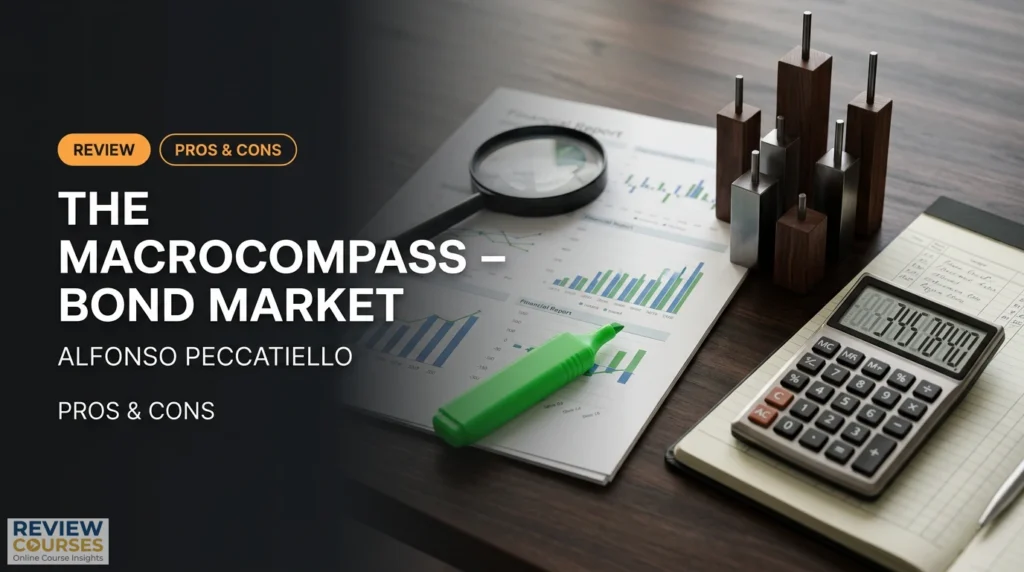
Navigating these complex waters is exactly what The Macrocompass aims to help investors do. Founded by Alfonso Peccatiello, widely known in the financial community as MacroAlf, the platform offers a specific premium training program called Monetary Mechanics. The goal of the program is to take the opaque, highly technical world of central bank operations and translate it into actionable frameworks for everyday investors.
With a price tag of EUR 499 (approximately $540 USD), this program promises to pull back the curtain on liquidity, real-economy money, and yield curves. But is it worth the steep investment for a retail trader, or is it too deeply entrenched in institutional jargon to be useful? This review breaks down the curriculum, the instructor's verified credibility, and the overall value proposition to help you make an informed decision before purchasing.
At a glance
|
Item |
Details |
|
Course name |
Monetary Mechanics |
|
Platform / Brand |
The Macrocompass |
|
Instructor |
Alfonso Peccatiello (MacroAlf) |
|
Category |
Crypto & Investing |
|
Current price |
EUR 499 (approx. $540 USD) |
|
Refund policy |
Not specified on the main landing page |
|
Intent fit |
Commercial investigation / Consideration |
|
Trust signals |
High (Instructor managed a $20B portfolio at ING Germany; active Trustpilot profile) |
What this review helps you decide
|
Question |
Why it matters |
|
Is the EUR 499 price justified? |
Macroeconomic education can often be found for free online. You need to know if this paid curriculum offers proprietary frameworks that justify the premium cost. |
|
Is the material too complex? |
Central bank balance sheets and reverse repo markets are notoriously dense topics. Understanding the difficulty level helps prevent buying a course you cannot comprehend. |
|
Who is Alfonso Peccatiello? |
In the finance education space, instructor credibility is everything. Verifying his institutional background ensures you are learning from a practitioner, not a marketer. |
|
How does this apply to trading? |
Theoretical macroeconomics is useless to a trader unless it can be applied to portfolio management. You need to know if this bridges the gap between theory and practice. |
Course overview
The Monetary Mechanics course is a specialized curriculum hosted on The Macrocompass platform. It is designed to demystify the complex, often misunderstood world of global monetary plumbing. For years, retail investors have been fed simplified narratives about "money printing" and inflation that fail to hold up under the scrutiny of actual market mechanics. This course attempts to correct those misconceptions by teaching students how the financial system actually operates behind closed doors.
The instructor, Alfonso Peccatiello, brings significant institutional weight to the program. Before launching his platform, he served as the Head of Investments for a $20 billion portfolio at ING Germany. This background is crucial because it means the curriculum is built on practical, institutional-grade experience rather than academic theory or retail trading guesswork. He understands how large pools of capital react to central bank policy shifts because he used to manage one of those pools.
Readers typically search for reviews of this course because they are caught between the high perceived value of the instructor's free content (such as his popular Substack articles and podcast appearances) and the reality of the EUR 499 price tag. Furthermore, search engine results pages (SERPs) show a mix of highly positive Trustpilot reviews praising the depth of the content, alongside Reddit threads where users debate the accessibility of the material or look for cheaper alternatives. This review aims to clarify exactly what you get for your money and whether the institutional perspective translates well for the average retail investor.
What’s likely inside the course
Based on verified curriculum details from the official platform, the Monetary Mechanics course is structured around five core lessons that progressively build on one another.
|
Theme area |
What it likely covers |
Confidence |
|
Lesson 1: Liquidity |
Defining what liquidity actually is in the modern financial system, moving beyond the buzzword to understand how it drives asset prices. |
Confirmed |
|
Lesson 2: Real-Economy Money |
The distinction between bank reserves (financial money) and the money that actually circulates in the real economy to drive inflation and growth. |
Confirmed |
|
Lesson 3: Monetary Plumbing |
A deep dive into the mechanics of the Treasury General Account (TGA), Reverse Repo facilities, and Central Bank Balance Sheets (QE/QT). |
Confirmed |
|
Lesson 4: Yield Curve (Part 1) |
The foundational mechanics of the yield curve, what drives different durations, and how it signals macroeconomic shifts. |
Confirmed |
|
Lesson 5: Yield Curve (Part 2) |
Advanced applications of yield curve analysis, likely tying together liquidity, central bank policy, and bond market reactions. |
Confirmed |
The curriculum is heavily focused on the structural realities of the financial system. Lesson 3, which covers monetary plumbing, is arguably the centerpiece of the program. Retail investors frequently misunderstand how the Treasury General Account (TGA) and Reverse Repo markets interact to drain or inject liquidity into the stock market. By breaking down these central bank balance sheet mechanics, the course aims to give students a leading indicator for market direction, rather than relying on lagging indicators like moving averages.
For investors who have previously explored the MacroCompass bond market analysis, the deep dive into yield curves in the final two modules will feel like a highly complementary progression. The yield curve is often cited as the ultimate truth-teller in financial markets, and understanding its nuances is critical for anyone looking to position a portfolio ahead of a recession or an economic boom. The course also touches on the Eurodollar system, a massive, offshore dollar market that heavily influences global credit but is rarely understood by retail participants.
Who this is for
This course is not a basic introduction to the stock market. It is built for a specific type of investor who is willing to put in the intellectual effort to understand complex, systemic financial forces. It is best suited for intermediate to advanced retail investors, aspiring macro analysts, and finance professionals who want to bridge the gap between textbook economics and real-world market reactions.
|
If you are… |
This may fit if… |
This may not fit if… |
|
A retail swing trader |
You want to align your medium-term trades with the underlying flow of global liquidity. |
You are looking for daily stock picks, chart patterns, or short-term technical analysis signals. |
|
A long-term investor |
You want to understand when to shift your portfolio between equities, bonds, and cash based on central bank cycles. |
You prefer a passive, set-and-forget index fund strategy and do not want to actively manage your allocations. |
|
A finance student |
You want to learn how institutional portfolio managers actually view the plumbing of the financial system. |
You are looking for a traditional academic certification or university credit. |
Learning experience and format
The Monetary Mechanics course is delivered digitally through the official platform. While the exact length of the video modules is not explicitly detailed on the main sales page, the structure implies a comprehensive, lecture-style format. Alfonso Peccatiello is known for his ability to use charts, data terminals, and visual metaphors to explain dense topics, and it is highly likely this teaching style carries over into the paid curriculum.
One critical factor to note regarding the learning experience is the lack of a clearly stated refund policy on the main landing page. Standard digital product terms usually apply in these scenarios, meaning that once you access or download the proprietary video content, refunds are generally not offered. Prospective students should verify the exact terms of service at checkout. Additionally, be cautious when researching policies online; search results sometimes surface a refund policy for a completely unrelated physical goods company called "Mecompass," which has absolutely nothing to do with this financial education platform.
Social proof for the learning experience is generally strong. The platform maintains an active Trustpilot profile where users frequently praise the instructor's clarity and depth of knowledge. However, discussions on forums like Reddit indicate that the material is dense and requires multiple viewings to fully absorb. Some Reddit threads also show users attempting to organize "group buys" to bypass the EUR 499 fee—a practice that violates terms of service and deprives the user of any official support or platform updates.
Pros and cons
|
Likely strengths |
Possible drawbacks or open questions |
|
Taught by a verified former institutional portfolio manager ($20B at ING). |
The EUR 499 price point is a significant investment for casual retail traders. |
|
Covers highly advanced, rarely taught topics like the TGA and Reverse Repo. |
Technical complexity may overwhelm beginners without a basic finance background. |
|
Dispels common retail myths about "money printing" and inflation. |
No explicitly stated refund policy on the main sales page. |
|
Strong social proof via Trustpilot and a large, engaged Substack following. |
Focuses on macro frameworks rather than providing direct, daily trading signals. |
The primary strength of this course is the undeniable credibility of the instructor. In an industry flooded with self-proclaimed gurus who have only ever traded their own small accounts, learning from someone who managed a $20 billion fixed-income portfolio offers a rare institutional edge. The curriculum tackles the exact mechanisms—like Quantitative Easing (QE) and Quantitative Tightening (QT)—that actually move markets, rather than relying on superficial analysis.
On the downside, the cost and the complexity are real barriers. EUR 499 is not a casual purchase, and the material requires serious study. If you buy this course expecting to be told exactly which stocks to buy on Monday morning, you will be disappointed. The lack of a transparent, risk-free refund policy also means you must be absolutely certain of your purchase before entering your credit card details.
Decision framework
|
Decision factor |
What to check |
Why it matters |
|
Your foundational knowledge |
Do you understand basic financial terms like bonds, equities, and inflation? |
If you do not know what a bond is, a deep dive into the yield curve and monetary plumbing will be entirely overwhelming. |
|
Your investment horizon |
Are you a day trader or a medium-to-long-term investor? |
Macroeconomic forces play out over weeks, months, and years. This knowledge is less useful for someone scalping 5-minute charts. |
|
Budget tolerance |
Are you comfortable spending EUR 499 on education with no guaranteed refund? |
Because digital access is usually final, you must view this as a sunk cost invested in your long-term financial education. |
Common mistakes to avoid
The most common mistake buyers make when purchasing advanced financial education is misaligning their expectations with the reality of the curriculum. Many retail traders assume that learning a complex institutional framework will immediately translate into a higher win rate in their personal brokerage accounts.
Purchasing an advanced financial framework is not a shortcut to wealth. Much like a student buying ewan Davies' PDF Empire Builder course and expecting a digital business to build itself without effort, buying a macro course will not automatically generate trading profits unless you put in the screen time to apply the concepts. You must be willing to track central bank balance sheets, monitor the Treasury General Account, and adjust your portfolio accordingly.
Additionally, avoid these specific pitfalls:
- Confusing liquidity with real-economy money: The course explicitly separates these two concepts. Assuming that central bank liquidity automatically equals consumer inflation is a mistake the course tries to correct; do not carry that bias into the lessons.
- Expecting a trading algorithm: This course teaches you how to read the macroeconomic weather, not how to build an automated trading bot.
- Ignoring the refund ambiguity: Do not purchase the course assuming you can simply ask for your money back if you find the material too difficult. Verify the terms before buying.
Alternatives to consider
If you are hesitant about the EUR 499 price tag or the specific focus on monetary plumbing, there are several alternative paths to consider.
If your primary goal is generating active cash flow rather than managing a long-term investment portfolio, you might be looking in the wrong educational category entirely. For instance, those focused on digital agency building often look toward rachel Pedersen's The Social Clique program, which serves a completely different financial objective than macroeconomic forecasting.
For those who definitely want to stay in the financial education space, consider these alternatives:
- Free Macro Newsletters: The instructor himself publishes extensive free content on Substack. Reading his free articles for a few months is an excellent way to gauge if you resonate with his teaching style before committing to the paid course.
- Academic Textbooks: If you want to learn about central banking, university-level textbooks on money and banking offer comprehensive knowledge, though they often lack the practical trading application provided by a former portfolio manager.
- Basic Retail Trading Courses: If you are still struggling with basic concepts like support, resistance, and simple moving averages, you may want to start with a foundational retail trading course before attempting to master the Eurodollar system and reverse repo markets.
FAQ
Is the Monetary Mechanics course for beginners?
No, this course is not designed for absolute beginners. It assumes a baseline understanding of financial markets and dives quickly into complex institutional concepts like central bank balance sheets, the Treasury General Account, and yield curve mechanics.
How much does the Monetary Mechanics course cost?
The course is currently priced at EUR 499, which is approximately $540 USD depending on current exchange rates. This is a one-time fee for access to the specific Monetary Mechanics curriculum.
Who is the instructor of The Macrocompass?
The instructor is Alfonso Peccatiello, widely known as MacroAlf. He is a former institutional portfolio manager who previously served as the Head of Investments for a $20 billion portfolio at ING Germany, giving him significant credibility in the fixed-income and macro space.
What is the difference between liquidity and real-economy money?
In the context of this course, liquidity generally refers to bank reserves and the financial money that drives asset prices (like stocks and bonds), whereas real-economy money refers to the funds circulating among consumers and businesses that drive actual economic growth and consumer inflation.
What is monetary plumbing?
Monetary plumbing refers to the underlying, structural mechanisms of the financial system. It includes the operations of central banks, the flow of reserves, repo and reverse repo markets, and how government treasury accounts interact with commercial banking liquidity.
Is there a refund policy for Monetary Mechanics?
A specific refund policy for the digital course is not explicitly stated on the main landing page. Because it is a digital information product, standard industry terms likely apply, meaning refunds are generally not provided once the content has been accessed.
Verdict
The Monetary Mechanics course by Alfonso Peccatiello is a highly credible, deeply technical dive into the macroeconomic forces that actually drive global markets. For the intermediate to advanced investor who is tired of superficial retail trading advice and wants to understand how institutional money managers view the world, this course delivers substantial value. The EUR 499 price tag is justified by the instructor's verified $20 billion portfolio management background and the proprietary frameworks provided.
However, this course is not for everyone. Absolute beginners, day traders looking for quick stock picks, and those unwilling to study dense financial mechanics should probably skip it. The lack of a clear refund policy also means you must be fully committed to the learning process before purchasing.
Conclusion
Ultimately, navigating the financial markets without understanding monetary plumbing is like trying to sail an ocean without understanding the tides. The Macrocompass provides a rare opportunity to learn these mechanics directly from a former institutional insider. If you have the budget, the baseline financial knowledge, and the patience to absorb complex material, the Monetary Mechanics course can significantly upgrade your framework for long-term investing and portfolio management.
Related courses
https://reviewcourses.online/mike-weinberg-the-sales-management-simplified-review/
https://reviewcourses.online/christine-carrillo-the-20-hour-ceo-review/
https://reviewcourses.online/eli-wilde-the-unstoppable-speaker-roadmap-review/