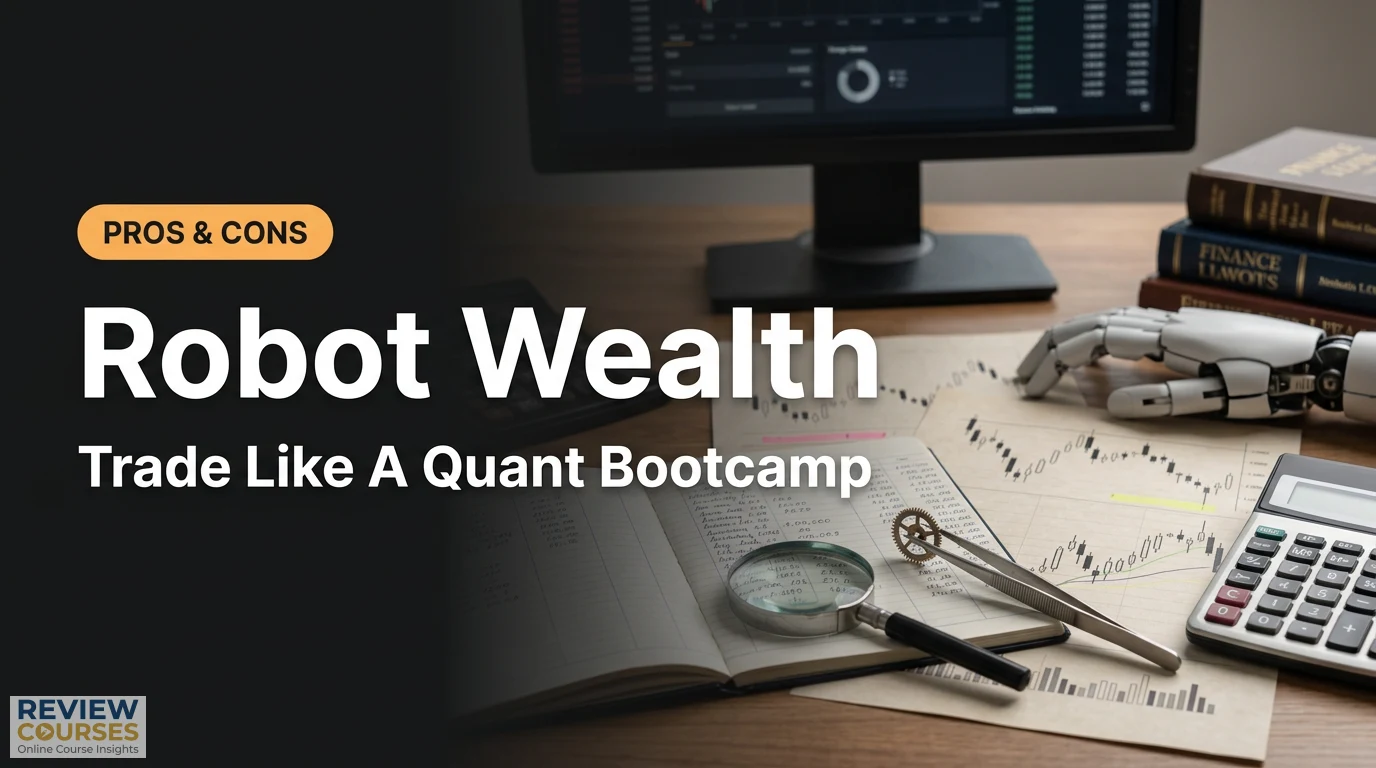
The transition from discretionary trading to systematic, data-driven market analysis is a significant hurdle for many retail investors. Relying on intuition, chart patterns, and emotional decision-making often leads to inconsistent results and severe screen fatigue. For those looking to remove human error from their execution, quantitative trading offers a compelling, albeit complex, alternative.
If you are evaluating the Robot Wealth course provided by Trade Like A Quant Bootcamp, you are likely searching for a structured pathway to build, test, and deploy algorithmic trading strategies. Bootcamps in the financial space promise to accelerate the learning curve, transforming everyday traders into systematic operators who rely on statistics rather than gut feelings. However, the transition requires more than just a basic understanding of market mechanics; it demands rigorous logic, mathematical foundations, and often, programming proficiency.
Because the barrier to entry for quantitative finance is notoriously high, choosing the right educational program is a critical first step. A poorly structured course can leave you overwhelmed with code you do not understand or, worse, trading a flawed algorithm that loses capital in live markets. Therefore, investigating the depth, support, and transparency of any bootcamp is essential before committing your time and money.
This review examines the available information surrounding this trading strategy program. Because specific details regarding pricing, exact curriculum modules, and refund policies are currently unverified, this guide will focus on what you should expect from a quant-focused bootcamp, how to evaluate its potential value, and the critical questions you must ask the provider before enrolling.
At a glance
|
Item |
Details |
|
Course name |
Robot Wealth |
|
Provider |
Trade Like A Quant Bootcamp |
|
Category |
Trading Strategy |
|
Intent fit |
Commercial investigation |
|
Buyer stage |
Consideration |
|
Pricing transparency |
Not verified |
|
Policy transparency |
Not verified |
|
Trust signal status |
Not verified |
What this review helps you decide
|
Question |
Why it matters |
|
Is the curriculum suited for beginners? |
Quant trading often requires prerequisites in math and coding; knowing the starting level prevents early frustration. |
|
What are the hidden costs? |
Beyond the course fee, algorithmic trading usually requires paid data feeds, software, and virtual private servers. |
|
Is the methodology transparent? |
You need to know if the bootcamp teaches first principles or just hands out "black box" scripts that you cannot modify. |
|
Are the policies clear? |
Without verified refund and access policies, your financial risk in purchasing the program is significantly higher. |
Course overview
The Robot Wealth program, hosted under the Trade Like A Quant Bootcamp umbrella, appears to target individuals who want to pivot away from manual, discretionary trading toward a systematic, rules-based approach. In the broader landscape of trading education, "quant" (quantitative) bootcamps are designed to bridge the gap between retail trading concepts and institutional-grade statistical analysis. Readers typically search for reviews of this specific program to determine if it provides a legitimate edge in the markets or if it simply repackages basic coding tutorials available for free elsewhere.
A bootcamp format implies an intensive, structured, and likely time-consuming educational experience. Unlike casual weekend courses, a true quant bootcamp should immerse students in data analysis, hypothesis testing, and strategy automation. The core philosophy behind such programs is that markets are highly efficient, and finding a profitable edge requires processing large datasets to uncover statistical anomalies that human eyes cannot detect.
Investors and traders looking into this program are usually trying to solve a specific pain point: inconsistency. By learning to trade like a quant, the goal is to build a portfolio of automated strategies that execute without hesitation, manage risk mathematically, and operate across multiple assets simultaneously. However, because the specific verified facts of this course are not specified, prospective students must carefully evaluate whether the provider actually delivers on the rigorous demands of quantitative education.
What’s likely inside the course
|
Theme area |
What it likely covers |
Confidence |
|
Quantitative foundations |
Statistical concepts, probability, and the scientific method applied to financial markets. |
Likely |
|
Programming and tools |
Introduction to languages like Python or R, and libraries used for data manipulation (e.g., Pandas). |
Likely |
|
Backtesting hygiene |
How to test strategies on historical data while avoiding look-ahead bias and curve fitting. |
Likely |
|
Live execution |
Connecting algorithms to broker APIs for automated trade execution and portfolio management. |
Likely |
|
Exact module count |
Specific number of video lessons, hours of content, or downloadable resources. |
Not specified |
Because the exact curriculum status is not verified, we can only project the standard components of a comprehensive quantitative trading bootcamp. Typically, these programs begin by breaking down the myths of retail trading and replacing them with statistical realities. You can expect early modules to focus heavily on data—how to source clean historical price data, how to format it, and how to handle missing variables.
From there, the curriculum likely moves into strategy ideation and backtesting. This is where students learn to translate a trading idea into code and test it against years of market history. A high-quality bootcamp will spend a significant amount of time teaching students how not to fool themselves with optimized backtests. Finally, the program is expected to cover the mechanics of live deployment, including server hosting, API integration, and monitoring algorithms for degradation over time.
Who this is for
This type of intensive training is generally best suited for individuals who already possess a highly analytical mindset. If you enjoy working with spreadsheets, analyzing statistics, and solving logical puzzles, a quant bootcamp aligns well with your natural inclinations. It is also heavily targeted at existing manual traders who are profitable but exhausted by the daily grind of watching charts, as well as software engineers who want to apply their coding skills to financial markets.
Conversely, this program is likely a poor fit for those seeking immediate, effortless income. Algorithmic trading requires a massive upfront investment of time and intellectual energy before a single automated trade is placed. If you are looking for daily trade alerts, simple chart patterns, or a "set and forget" wealth button, the rigorous nature of a quant bootcamp will likely prove overwhelming and frustrating.
|
If you are… |
This may fit if… |
This may not fit if… |
|
A manual trader |
You want to automate your proven rules to reduce screen time and emotional errors. |
You refuse to learn basic programming or statistical concepts. |
|
A software developer |
You want to learn market mechanics and how to apply your code to financial data. |
You expect coding skills alone to guarantee trading profits. |
|
A complete beginner |
You are highly dedicated, patient, and willing to learn math, coding, and finance simultaneously. |
You want to start making money in your first few weeks of learning. |
Learning experience and format
The learning experience in a bootcamp environment is traditionally rigorous and fast-paced. While the exact delivery method of this specific program is not verified, bootcamps generally utilize a mix of on-demand video lectures, live Q&A sessions, and heavy practical assignments. You should anticipate spending more time writing code, debugging scripts, and analyzing spreadsheets than actually watching videos.
Similar to the intensive pacing found in the youTube Profits Challenge Bootcamp, a quant bootcamp usually demands significant daily screen time and a commitment to pushing through complex, frustrating roadblocks. Learning to code while simultaneously learning market dynamics is a dual challenge. Therefore, community support—such as a private Discord or forum where students can troubleshoot code together—is often a critical component of these programs. You should verify with the provider whether you will have direct access to instructors or a community of peers to help you when your algorithms inevitably fail to compile.
Furthermore, you must clarify the access length. Some bootcamps offer lifetime access to the materials, while others restrict access to a specific cohort window (e.g., 12 weeks). Given the steep learning curve of quantitative finance, lifetime access or extended support is highly preferable so you can revisit complex statistical concepts as your practical experience grows.
Pros and cons
|
Likely strengths |
Possible drawbacks or open questions |
|
Promotes a logical, emotionless approach to trading. |
Pricing and refund policies are currently unverified. |
|
Teaches highly transferable data analysis skills. |
May require expensive third-party data subscriptions. |
|
Focuses on statistical edge rather than guesswork. |
The learning curve for coding and math can be severe. |
|
Potential to scale trading across multiple assets. |
Unclear if the curriculum is updated for current market conditions. |
The primary advantage of learning to trade like a quant is the removal of human emotion from the execution process. By relying on backtested data and automated execution, you eliminate the hesitation, fear, and greed that destroy most retail accounts. Additionally, the skills learned in a rigorous quant program—such as Python programming, data wrangling, and statistical modeling—are highly valuable and transferable to careers outside of trading, such as data science or financial analysis.
On the downside, the lack of verified transparency regarding the course's pricing, policies, and exact curriculum is a significant risk factor. Without knowing the refund policy, you are taking a blind financial leap. Furthermore, algorithmic trading is not free; even after paying for a bootcamp, you will likely need to budget for high-quality historical data feeds, live market data subscriptions, and virtual private servers to run your algorithms 24/7. Prospective students must weigh these ongoing operational costs against the unverified upfront cost of the bootcamp itself.
Decision framework
|
Decision factor |
What to check |
Why it matters |
|
Prerequisites |
Does the provider require prior coding or math experience? |
Enrolling without the necessary baseline skills will result in falling behind immediately. |
|
Software requirements |
What languages (Python, R, C++) or platforms are taught? |
You want to ensure the tools taught are industry-standard and compatible with your preferred broker. |
|
Policy transparency |
Is there a clear, written refund policy and access timeline? |
Protects your capital if the course quality is poor or the material is too advanced. |
|
Instructor credibility |
Can the instructors prove their own systematic trading experience? |
You need to learn from practitioners who have actually deployed capital algorithmically, not just theorists. |
When deciding whether to pursue this specific bootcamp, your first step should be to contact the provider directly to resolve the unverified aspects of the program. Ask for a detailed syllabus to understand exactly what programming languages and statistical models are covered. If the course relies on proprietary, closed-source software rather than open-source languages like Python, you should proceed with caution, as this limits your flexibility and ties you to their specific ecosystem.
You must also evaluate your own bandwidth. Quantitative trading cannot be mastered in a few hours a week. It requires deep, uninterrupted focus to build and test models. If your current lifestyle does not allow for dedicated study and coding time, a bootcamp format may not be the right vehicle for you at this moment, regardless of the curriculum's quality.
Common mistakes to avoid
The most frequent mistake new quantitative traders make is falling victim to "curve fitting" or overfitting their backtests. It is incredibly easy to write an algorithm that looks like a money-printing machine on historical data by tweaking the parameters until they perfectly match past market movements. However, these over-optimized strategies almost always fail in live trading because they are tuned to historical noise rather than a robust underlying market inefficiency. A good bootcamp should spend extensive time teaching you how to validate strategies on out-of-sample data to prevent this.
Another common pitfall is underestimating the impact of transaction costs. Beginners often build algorithms that trade dozens of times a day, showing massive theoretical profits. They fail to account for broker commissions, bid-ask spread, and slippage (the difference between expected price and actual execution price). When these real-world frictions are applied, the theoretical profits often turn into severe losses.
Finally, traders often forget that algorithmic trading is just one vehicle; understanding the broader psychology of wealth accumulation strategies is equally important to avoid self-sabotage. Even with an automated system, human intervention is the weakest link. Traders frequently panic and manually turn off their algorithms during a normal statistical drawdown, completely ruining the mathematical expectancy of the system. Trusting the math during losing streaks is a psychological hurdle that code alone cannot solve.
Alternatives to consider
If you are hesitant about committing to an unverified bootcamp, there are several alternative paths to gaining quantitative trading skills.
- Self-taught programming paths: You can learn Python and data science fundamentals through low-cost, general-purpose coding platforms. Once you have the coding foundation, you can apply it to finance by reading established academic textbooks on algorithmic trading. This path is much cheaper but requires immense self-discipline and takes significantly longer.
- University extension programs: Many accredited universities now offer online certificates in financial engineering or data science. These programs provide verified credentials, structured academic rigor, and transparent pricing, though they may be more theoretical and less focused on immediate retail trading application.
- Other specialized quant programs: You might also compare this against other specialized quantitative training paths, such as the quantreo Alpha Quant Program, to see which curriculum aligns best with your current programming skill level and trading goals. Comparing multiple syllabi will help you understand what a standard quant curriculum should look like.
Ultimately, the best alternative depends on your budget, your current technical proficiency, and whether you prefer a guided, cohort-based experience or a solitary, self-paced journey.
FAQ
Do I need to know how to code before taking this bootcamp?
Not specified, but it is highly likely that you will need at least a basic understanding of programming logic. Most quant bootcamps teach Python or R, and while some start from scratch, having prior exposure to coding will significantly reduce your initial overwhelm.
What trading platforms or software are required?
This is not verified in the available data. However, standard quantitative courses typically require you to install open-source environments like Jupyter Notebooks, use data libraries like Pandas, and eventually connect to brokerages that offer robust APIs, such as Interactive Brokers.
Is the pricing and refund policy transparent?
Pricing: not covered in this review, as the exact costs and refund terms are currently unverified. You must contact the provider directly to obtain a written guarantee and a clear breakdown of the tuition before handing over any payment details.
Can this bootcamp guarantee profitable trading algorithms?
No course, bootcamp, or instructor can guarantee profits in the financial markets. Quantitative trading is about finding a statistical edge and managing risk, but market regimes change, and algorithms that worked yesterday can fail tomorrow.
Verdict
The Robot Wealth program by Trade Like A Quant Bootcamp represents a potentially valuable step for traders looking to transition from discretionary guessing to systematic execution. If the curriculum delivers rigorous instruction on data analysis, backtesting hygiene, and live deployment, it could save aspiring quants hundreds of hours of trial and error. It is best suited for analytical, patient individuals who are willing to put in the hard work required to learn coding and statistics.
However, because critical details regarding pricing, refund policies, and the exact curriculum are unverified, we cannot offer a blanket recommendation. You should probably skip this specific program if you are unable to get clear, written answers from the provider regarding costs, software requirements, and support access. Never invest in a high-ticket educational program without verifying exactly what you are paying for and what protections are in place if the material does not meet your expectations.
Conclusion
Moving into quantitative trading is a commendable goal that can ultimately lead to more consistent, emotion-free market participation. Bootcamps are designed to accelerate this difficult transition by providing structure and expert guidance. While the premise of this trading strategy course is highly appealing to data-driven investors, the lack of verified transparency means the burden of due diligence falls entirely on you. Take the time to compare this program against other educational avenues, demand clear answers regarding the syllabus and policies, and ensure you are fully prepared for the steep learning curve ahead before making a financial commitment.
Related courses
https://reviewcourses.online/chris-orzechowski-email-flow-bootcamp-review/
https://reviewcourses.online/quantfactory-become-a-quant-trader-bundle-review/
https://reviewcourses.online/trade-mindfully-the-essential-wyckoff-playbook-review/